Introduction
위치 | 서울 성수동 271-2
용도ㅣ복합문화시설
대지 면적ㅣ1830.4㎡
건축 면적ㅣ6772.48㎡
층수 | B4F – 9F
Location | 271-2, Seongsu-dong, Seoul, Republic of Korea
Programㅣcommunity facility
Site Areaㅣ1830.4㎡
Building Areaㅣ6772.48㎡
Floors | B4F – 9F
Agenda
현대 사회는 끊임없는 연결 속에서 오히려 더 큰 불안과 결핍을 느낀다. FOMO(Fear of Missing Out) – 무언가를 놓칠지도 모른다는 두려움은 사람들을 끊임없이 이동하게 만들고, 결국 관계의 지속성을 약화시킨다. 이에 본 프로젝트는 ‘머무름’을 통해 관계를 회복하고자 한다. 한 장소에 오래 머물며, 사람과 사람이 다시 엮이고, 그 시간이 공간의 형태로 남는 건축을 제안한다.
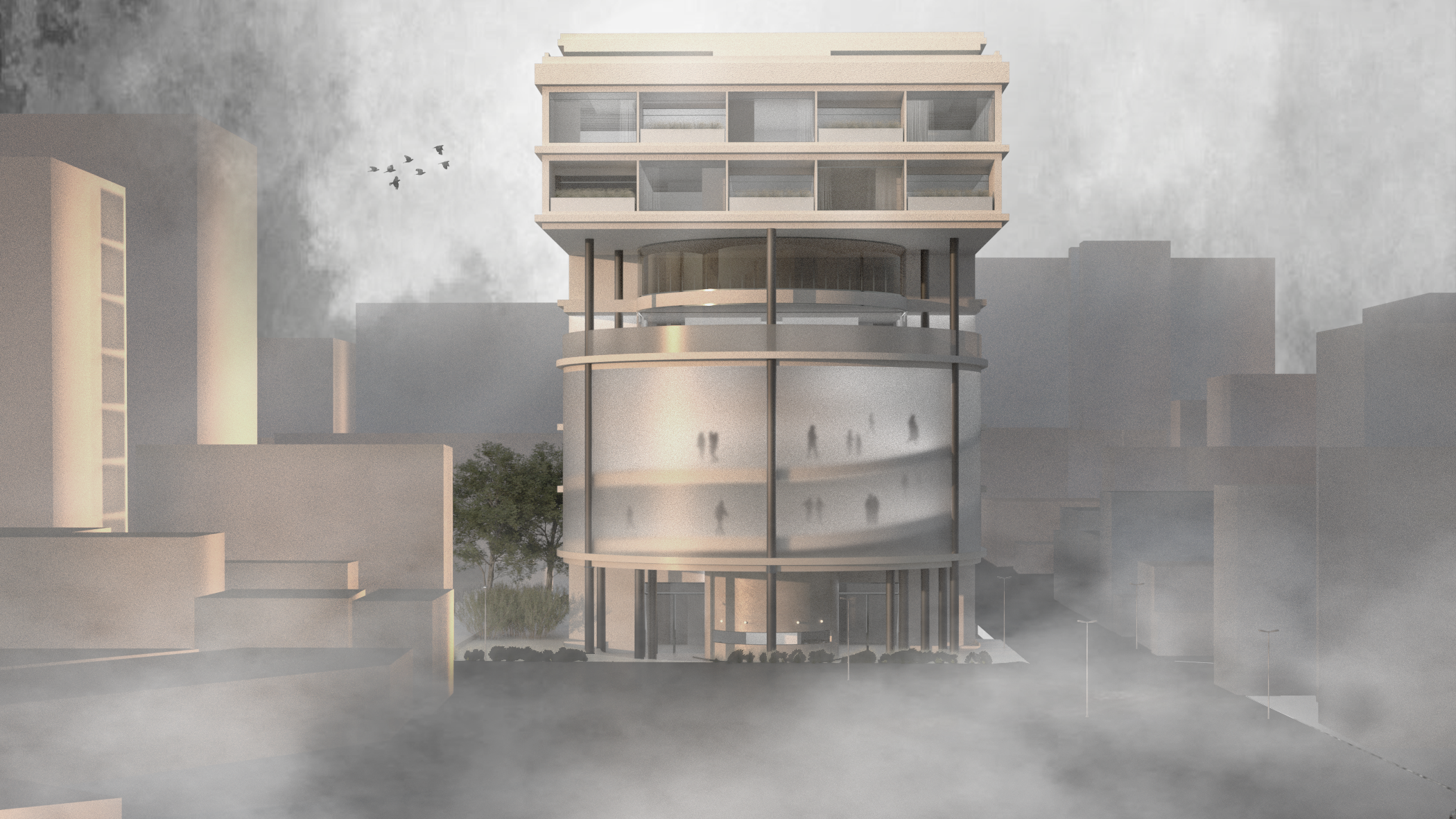
전시장은 관람객의 움직임이 곧 건축의 형태가 되도록 설계한다. 완만한 슬로프로 이어지는 동선과 이를 감싸는 반투명한 입면은 그날의 발자취를 은은히 비추며, 매 순간 새로운 표정을 만들어낸다. 건축은 더 이상 완성된 틀이 아니라, 사람과 함께 숨쉬고 변화하는 유기적 존재로 거듭난다.
가구전시장과 가구호텔은 이 개념을 구체화한다. 전시장은 단순한 감상의 공간이 아닌, 머무르고 대화하는 플랫폼으로 작동하며, 이어지는 호텔은 전시된 가구 속에서 실제로 생활을 체험하게 함으로써 일상 속 관계를 되살린다. 이 프로젝트는 형태를 실험하는 건축이 아니라, ‘사람이 만든 흔적이 곧 건축이 되는 과정’을 탐구한다. 머무는 시간이 관계를 남기고, 그 관계가 공간을 완성한다.
Modern society, despite being endlessly connected, experiences an even deeper sense of anxiety and deprivation. FOMO (Fear of Missing Out) – the fear of being left out – drives people into constant movement, ultimately weakening the continuity of relationships. This project seeks to restore those relationships through the act of staying. It proposes an architecture where people remain in one place long enough for time and relationships to intertwine, leaving traces that take on spatial form.
The exhibition hall is designed so that the movement of visitors shapes the architecture itself. A gentle, continuous slope and translucent glass façade softly reveal the traces of those who pass, creating a new expression with every moment. Architecture here is no longer a fixed frame, but a living, breathing organism that transforms together with its users.
The Furniture Showroom and Furniture Hotel embody this concept. The showroom is not merely a space for viewing objects but a platform for staying, conversing, and connecting. The adjoining hotel, furnished entirely with the exhibited pieces, allows visitors to experience life within the display itself – reviving human relationships within daily life. This project does not pursue architectural form as an end in itself; rather, it explores the process in which human traces become architecture. The time we stay leaves relationships, and those relationships complete the space.
Concept

Site


성수는 빠르게 변화하는 트렌드의 중심이자, 팝업 공간들이 끊임없이 생겨나는 도시이다. 이곳에서 사람들은 새로운 것을 경험하기 위해 끊임없이 이동하지만, 머무는 시간은 짧고 관계는 단절된다. 건축의 일시성이 도시의 정체성을 대체하며, ‘지속성’과 ‘공동체’는 점점 사라져가고 있다.
본 프로젝트는 이러한 성수의 현상을 단순히 소비의 결과로 보지 않고, 오히려 머무름을 통해 관계를 회복할 수 있는 건축적 가능성으로 확장한다.
Seongsu has become the epicenter of ever-changing trends – a city filled with pop-up spaces that appear and disappear overnight. People move constantly in search of new experiences, yet their time in each place is brief, and genuine connections fade away. Architecture here has become transient, mirroring the impermanence of urban life.
This project views such transience not as a limitation, but as an opportunity to rediscover architecture as a medium of staying and reconnecting. From a city of short visits to one of lingering presence, it envisions a new Seongsu where people and places once again intertwine.
Design

메인 프로그램인 전시장과 호텔의 성격과 접근성을 고려하여, 문화시설은 개방성과 유동성이 요구되는 하층부에, 조망과 프라이버시가 중요한 호텔은 상층부에 배치하였다. 이후 컨셉에서 제시한 건축의 목적에 맞추어, 각 공간의 성격에 따라 형태를 유기적으로 구성하였다.
Considering the nature and accessibility of the main programs – the exhibition hall and the hotel – the cultural facilities were placed on the lower levels, where openness and public flow are emphasized, while the hotel was positioned on the upper floors, where views and privacy are essential. Subsequently, the overall form was composed organically according to the spatial characteristics, aligning with the architectural intent defined by the project’s concept.
Program


Drawings


Section

Images


credit